Meet the robot scientists transforming research discovery
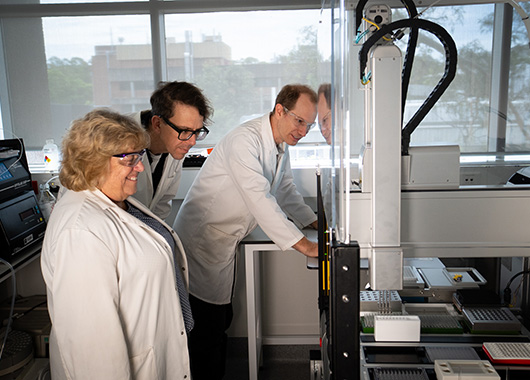
University of Newcastle scientists are trialling two advanced chemistry robots capable of rapidly testing thousands of chemical combinations, opening new opportunities in medicines, critical minerals, water treatment and advanced manufacturing.
The new systems form part of an NSW-wide initiative bringing together researchers from the University of Newcastle, University of Wollongong, UNSW and the University of New England to create a connected network of six AI-enabled chemistry platforms with robots located at universities across the state.
The collaborative project is funded through a $1.99 million Australian Research Council Linkage Infrastructure, Equipment and Facilities (LIEF) grant, the largest LIEF grant awarded nationally in the 2025 funding round.
Combining robotics, automation and machine learning, the technology will significantly accelerate the discovery of new molecules and materials for use across a range of industries.
University of Newcastle Professor Erica Wanless said the capability represents a major step forward in how chemical research is conducted.
“One of the most exciting aspects of this technology is the sheer scale at which we can now work,” Professor Wanless said.
“Traditionally, a chemist might run experiments one by one at a lab bench. These robots allow us to explore thousands of chemical possibilities much more rapidly, generating valuable data that helps guide the next stage of discovery.
“That has the potential to significantly accelerate research across areas such as medicines, critical minerals, advanced materials and manufacturing.”
Installed in a University of Newcastle laboratory at Callaghan Campus, the two robots can run experiments around the clock and use machine learning to help identify the most promising experiments to pursue.
“This intelligent automation helps us make faster, more informed decisions,” Professor Wanless said.
As part of the broader NSW network, researchers will be able to access specialised capabilities and collaborate with partner institutes across the state to share knowledge and accelerate innovation.
“The strength of this initiative is that these systems won’t operate in isolation,” Professor Wanless said.
The University of Newcastle’s two systems support key research strengths in medicinal chemistry and particle-liquid formulations, building on expertise in pharmaceuticals, critical minerals, and advanced materials.
“Newcastle has internationally recognised strengths in particle and solution science,” Professor Wanless said.
“This technology allows us to investigate complex formulations in a much more systematic and data-driven way, creating opportunities for both research and industry.”
Potential applications include mineral processing, biotechnology, water treatment, coatings, disinfectants, personal care products and other advanced manufactured materials.
Professor Wanless said the technology would also play an important role in preparing the next generation of researchers.
“Our students will gain hands-on experience with the automation and artificial intelligence technologies that are transforming research and advanced manufacturing around the world,” she said.
“This capability strengthens Newcastle's position in advanced chemistry and helps ensure NSW remains at the forefront of the next generation of chemical discovery.”
National recognition for local business advisor and centre
Business Advisor & trainer Brooke Phillips, part of the team at The Business Centre (Newcastle Region), has won a presti...

Hunter Valley stars in record-breaking international visitation to NSW
The popularity of the Hunter Valley as a world-wide tourism destination has played a significant role in NSW’s record-br...

John Hunter Health and Innovation Precinct unveiled
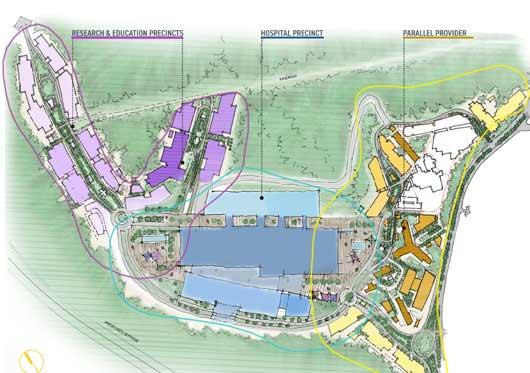
The Master Plan for the NSW Government's John Hunter Health and Innovation Precinct, which includes a $780 million inves...
Hunter Innovation Forum
Innovation is essential to sustainability and competitiveness in a changing world.