The KPI trap in performance management
Diane Loong
Skildare
Many organisations fall into the trap of using KPI’s as the primary Performance Management metric. KPI’s in their traditional format (i.e. based on black and white measures such as revenue/profit/sales volumes etc.), do not support employee Performance Improvement.
Rather this approach dilutes the importance of organisational values and creates a workforce culture focussed on short-term numbers verse continuous improvement.
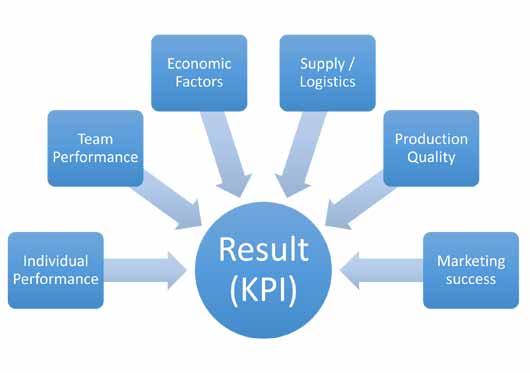
KPI’s are important for measuring the effectiveness of any given strategy, however they are ineffective when used as a Performance Management metric. This is because traditional KPI’s are the result of multiple inputs (individual performance being just one of them). An example of these multiple inputs for a sales role is depicted to the right.
The effect of giving an individual a traditional KPI target is that it implies that the actual result is more important than ‘how’ the result was achieved. To manage (or more correctly, improve) performance in an employee, the focus should be on ‘how’ they execute their role.
If the employee performs all tasks in accordance with the organisations values implicitly, then they will maximise their ability to achieve a good result. If their outcome falls short of the KPI, then the onus lies with the leadership and their approach to the achievement of targets, not the individual.
On the flip side however, if the employee is told that the result is more important than the ‘how’, then they will likely cut corners and behave in a manner that is not inline with the organisations values.
The long-term implication of this outcome is obviously disastrous. Moreover, employees focussed on just ‘meeting budget’ will inspire a mediocre culture where individuals are more focussed on survival rather than improvement.
Behaviour focussed Performance Management requires leaders to actually lead, coach and mentor their team members. This requirement is not a secondary duty for the leader; it is their primary role. Organisations and teams that adopt this mantra enjoy a culture of continuous improvement and ongoing organisational success.
For further information contact Diane at Skildare on (02) 4940 8743, email diane@skildare.com.au or visit www.skildare.com.au
 Diane Loong
is a passionate and pragmatic Human resources specialist with a proven track record of improving her clients’ general HR and leadership capabilities. In her 20 year career Diane has gained broad management and commercial experience with a demonstrated ability to work at the most senior level.
Other Articles from this issue
Bloomfield and Glencore to acquire Integra coal operations in the Hunter
The Bloomfield Group and Glencore Plc have signed binding agreements to acquire the Integra coal mine complex from Vale ...

Austin Engineering joint venture in the Hunter
Austin Engineering has formalised a joint venture with Rutherford based BK Plant Repairs and Maintenance.
Larger offices for performHR
After out-growing their office in Hamilton, performHR has established their new headquarters on Glebe Road, The Junction...

Guiding organisations in realising the potential in workplace
Emma Rutter, a Property Advisor with APP Corporation is working with businesses to help them articulate and achieve the...